
In Dubai’s electric food scene, a specialist graphic design agency isn’t just another vendor—it’s your most critical partner for growth. They’re the ones who turn your brand’s visual identity into a real-world tool that grabs attention on crowded delivery apps and bustling streets, translating visual appeal directly into business results.
Why Your F&B Brand Needs a Specialist Design Partner in Dubai
Let’s be honest: in Dubai’s food and beverage market, standing out is a daily battle. Your brand is fighting for eyeballs on Instagram feeds, Talabat listings, and the actual streetscape. This is exactly where a generic, one-size-fits-all design approach will let you down. A specialist F&B graphic design agency becomes your strategic ally for survival and, ultimately, success in this fiercely competitive environment.
The distinction is crucial. A generalist agency might design a beautiful logo, but a specialist understands the intricate psychology of a diner in Dubai. They know how to engineer a menu that subtly guides customers toward high-profit items or design takeaway packaging that becomes a walking advertisement long after the food is gone.
The Strategic Edge of Industry Focus
When you choose an agency that lives and breathes the F&B industry, you gain a massive advantage. They don’t just see fonts and colours; they see tools to solve the specific business problems that are unique to restaurants, cafes, and cloud kitchens.
- Cultural Fluency: They get the local culture and diner expectations, making sure your branding connects with a diverse audience without feeling generic or out of touch.
- Operational Smarts: They understand the fast-paced reality of restaurant operations. This translates to menus that are easy for staff to use, signage that’s clear from a distance, and digital assets optimised for quick ordering on a tiny screen.
- Profit-Driven Design: Their work is directly linked to your bottom line. Every choice, from the layout of a delivery app banner to the texture of a physical menu, is made with the goal of increasing your average order value and winning repeat business.
Specialist F&B Agency vs Generalist Design Firm
It’s tempting to think any good designer can create a great menu, but the nuances of the F&B world make a huge difference. Here’s a quick breakdown of what you get when you partner with a specialist versus a generalist.
| Criteria | Specialist F&B Agency | Generalist Design Agency |
|---|---|---|
| Industry Knowledge | Deep understanding of diner psychology, menu engineering, and operational challenges. Knows the Dubai market inside out. | Limited F&B experience. Applies broad design principles that may not be optimised for restaurant success. |
| Design Approach | Strategic and profit-driven. Focuses on ROI, customer flow, and increasing average order value. | Primarily aesthetic. Aims for a “beautiful” design without necessarily connecting it to business goals. |
| Portfolio | Filled with menus, packaging, app visuals, and campaigns for restaurants, cafes, and cloud kitchens. | Diverse portfolio across multiple industries (tech, real estate, fashion), but lacks deep F&B case studies. |
| Speed & Efficiency | Familiar with F&B timelines and needs. No learning curve required, allowing for quicker, more relevant work. | Requires extensive briefing on industry specifics. May need more revisions to get things right. |
The takeaway is simple: a generalist might make you look good, but a specialist will help you sell more. They’re not just designing; they’re solving business problems specific to your industry.
The creative economy in the UAE is absolutely booming. Dubai’s graphic design scene is expanding rapidly, with the Middle East market hitting $0.595 billion in sales revenue in 2024. This growth is fuelled by Dubai’s position as a global hub where local tastes meet international trends, making a skilled, specialist design partner more critical than ever.
A true F&B design partner does more than just create visuals; they build a cohesive brand experience. They make sure the feeling a customer gets from your Instagram post perfectly matches the experience of holding your menu and tasting your food.
Beyond Aesthetics: The Tangible ROI
Investing in a specialist agency delivers a real, measurable return. We need to think beyond just having a “pretty” brand. The real goal is to build a recognisable and trusted name in a city where diners have endless options. A cohesive and strategic visual identity builds loyalty, making customers choose you again and again.
This strategic mindset extends to every single touchpoint. For example, an agency with F&B experience will instinctively know how your brand needs to appear on a small mobile screen for delivery apps versus on large-format signage for a new location. They’ll also know how to collaborate with other creatives, like photographers and interior designers, to create a completely seamless brand world.
If you’re looking to integrate various creative services, understanding how an interactive agency in Dubai operates can provide even more valuable insights. At the end of the day, it’s all about converting visual excellence into measurable growth for your restaurant or cafe.
How to Look Past the Pretty Pictures in an Agency’s Portfolio
Any design agency can throw together a gallery of nice-looking images. Your job, as a smart F&B owner, is to see right through that. An agency’s portfolio is where you uncover their real value—not just as artists, but as business partners who get the Dubai food scene. You have to move beyond “I like how that looks” and start asking why their designs actually work.
This isn’t just about judging aesthetics; it’s about spotting strategic thinking. Does their work just look cool, or does it solve a real problem for the client? A truly great portfolio shows how smart design choices lead to a better customer experience and, ultimately, more money in the bank.
Look for F&B Specificity and Results
First things first: filter for industry experience. An agency that mainly designs for tech startups or real estate developers won’t understand the unique, fast-paced world of food and beverage. You need to see proof that they get your challenges.
When you’re looking at their past work, ask yourself:
- Do they know how to design a menu that sells? Don’t just look for pretty fonts. Look for a menu that’s cleverly laid out. Do they use design tricks to guide the eye toward high-margin dishes? Is it easy to read, even in a dimly lit restaurant?
- Is their packaging practical? A takeaway bag is a moving advertisement. Do their designs actually stand out on a crowded street? More importantly, is the packaging built to survive a trip with a delivery driver and still look good?
- How’s their digital game? Really dig into their designs for social media ads, Talabat banners, or QR code menus. Do the visuals make you stop scrolling? Is their digital menu experience smooth and intuitive, or is it a frustrating mess that makes people give up on ordering?
An agency that showcases a mix of successful F&B projects—from high-end restaurants to scrappy cloud kitchens—proves they’re versatile. It’s a huge green flag that they can adapt their style to fit your specific brand.
Assess Brand Consistency Across All Touchpoints
A killer logo is a great start, but it’s just one piece of the puzzle. The real test is whether an agency can build a cohesive brand world that feels the same everywhere a customer interacts with it. In a market as competitive as Dubai, inconsistent branding just creates confusion and kills trust.
The goal is to create a seamless brand experience. A customer should feel the same brand essence whether they are looking at your Instagram feed, holding your physical menu, or receiving their delivery order.
As you click through their case studies, hunt for this consistency. Does the vibe from a branding project carry over to the website, the social media graphics, and the in-store posters? You want an agency that thinks about the entire customer journey, not just isolated design tasks.
For instance, if a brand’s identity is meant to feel rustic and artisanal, does that feeling come through in the texture of the menu paper, the font on the website, and the props used in the food photography? This obsessive attention to detail is what separates a good agency from a great one. You can see how we approach this in our own projects and case studies.
Identify Strategic Thinking Behind the Visuals
This is the most critical part. Every single design choice should have a purpose. A beautiful design that doesn’t help you sell more food is, frankly, a waste of money. You need to put on your business owner hat and analyse their work from a strategic angle.
This is especially true in Dubai, where a graphic design agency is a key ingredient for F&B success. Agencies here serve a diverse market where 41% of clients are medium-sized businesses like established cafes, and another 38% are startups, including innovative cloud kitchens. Businesses are turning to agencies for branding that delivers measurable results. One agency’s client, for example, saw an 11.76% jump in engagement rates and a 146.91% increase in time spent on their site in just six months.
Look for proof that the agency thinks beyond just making things look good. Did they design a loyalty card that was simple and compelling enough to actually bring customers back? Did they create in-store signage that successfully upsold people on desserts? That’s the kind of strategic thinking that directly impacts your bottom line.
Key Questions to Uncover Your Ideal Design Partner
Your first meeting with a potential graphic design agency in Dubai is much more than a price check—it’s an audition. You’re looking for a long-term business partner, not just a supplier. To get past the polished sales pitch and see what they’re really made of, you need to ask questions that reveal their strategic thinking and genuine passion for the F&B world.
Forget the generic stuff. It’s time to dig deeper.
With the right questions, you can quickly tell the difference between a team that just follows instructions and a partner who will actively help you grow. The goal is to find someone who thinks like a restaurant owner, not just a designer.
Probing Their Strategic Approach
Start by steering the conversation towards strategy, not just pretty pictures. Their answers here will show you if they connect design to real-world business results or if they’re just focused on aesthetics. A true partner will always tie their work back to your goals, whether that’s boosting sales or building a loyal following.
Here are a few questions to get the ball rolling:
- “How do you approach menu engineering to influence diner choices and increase average spend?” A great answer won’t just be about fonts and colours. They should talk about visual hierarchy, the “golden triangle” of eye movement, and using design tricks like boxes or icons to push your high-margin dishes. They should sound more like a business consultant than an artist.
- “Walk me through an F&B project where the client’s budget was tight. How did you deliver great results without compromising on quality?” This question is all about their problem-solving skills. Look for answers that show creativity under pressure—maybe they prioritised the most essential assets, found clever production hacks, or suggested cost-effective solutions that still packed a punch.
- “What’s your process for understanding our target audience and the local Dubai culture before you even start designing?” A top-tier agency will immediately talk about market research, checking out your competitors, and building customer personas. They need to have a clear plan for making sure their designs actually connect with your specific customers in this unique market.
Understanding Their Process and Collaboration Style
How an agency works is just as important as the work they create. A chaotic process or poor communication can completely derail a project, no matter how talented the designers are. These questions help you figure out if they’re professional and what it would actually be like to work with them day-to-day.
A smooth workflow is critical, especially when you need design to sync up with your other marketing efforts. For instance, you could ask how they would collaborate with a Dubai-based marketing agency to ensure your brand’s look and message are perfectly aligned everywhere.
A true partnership isn’t about handing over a brief and waiting for the final files. It’s a collaborative dance where your industry knowledge and their design expertise combine to create something powerful. The best agencies make you feel heard and involved every step of the way.
The UAE’s graphic design market is a serious player, making up 2% of a global industry worth $49.125 billion. It’s set to grow at a 3.1% rate through 2031. The best agencies in Dubai don’t just design logos; they create entire brand environments, which is exactly what an F&B business needs to build a cohesive identity. It’s interesting to note that 46% of design clients are startups—perfect for new cloud kitchens—while 24% are medium-sized businesses like cafes. You can find more stats like these over on Superside.com.
Gauging Their F&B Expertise and Passion
Finally, you need to find out if they actually love the food industry. A team that’s passionate about F&B will go the extra mile because they’re personally invested in the world you operate in. That enthusiasm almost always leads to more creative and effective work.
Try these questions to see if they’ve got that spark:
- “From a design perspective, what are some of your favourite F&B brands in Dubai, and why do they stand out to you?”
- “How do you stay on top of food trends and what diners are looking for here in the region?”
- “Describe how you’d weave professional food photography or 3D visuals into a branding project for us.”
Their answers will tell you everything you need to know. You’ll quickly see if they’re just another generic agency or a dedicated team of F&B specialists who can truly help your brand shine.
Decoding Agency Pricing and Project Scope in Dubai
Talking about money can feel awkward, but it shouldn’t. Getting a handle on how a graphic design agency in Dubai prices its work is the first step to setting a realistic budget and kicking off a great partnership. This isn’t about hunting for the cheapest quote; it’s about finding the best value and making sure your F&B brand gets exactly what it needs to win.
In the Dubai market, you’ll generally find agencies work in one of two ways: project-based fees or monthly retainers. Each has its pros, and the right one for you really boils down to your immediate needs and long-term vision.
A project-based fee is as straightforward as it sounds. You’ve got a specific, one-off job in mind—maybe a full brand identity for your new cafe or a fresh design for your takeaway packaging. The agency gives you a single price for that clearly defined project, and that’s what you pay. It’s clean, predictable, and perfect when you have a distinct task to tick off the list.
On the other hand, a monthly retainer is all about ongoing partnership. This model is a game-changer if you need consistent design support for social media content, promo flyers, menu updates, or ad campaigns. You pay a set fee each month for a certain amount of the agency’s time, effectively making them a creative extension of your in-house team.
Defining a Rock-Solid Scope of Work
No matter which pricing model you go with, the single most important document you’ll create is the Scope of Work (SOW). Trust me, a vague SOW is a recipe for disaster. It leads to surprise costs, blown deadlines, and a whole lot of frustration. A detailed SOW, however, is your best friend—it ensures everyone is on the same page from day one.
For any restaurant or cafe, your SOW needs to be crystal clear. It should list every single deliverable you expect. Don’t just write down “logo”; get into the nitty-gritty of what that actually means.
- Logo Suite: This isn’t just one file. It should include a primary logo, a secondary version (maybe stacked or horizontal), and a simplified icon or submark for tiny spaces like social media profiles. You’ll also need it in full colour, black, and white, with files optimised for both print (CMYK) and digital (RGB) use.
- Brand Guidelines Document: Think of this as your brand’s bible. It needs to lock in your colour palette (with specific codes), typography rules, logo usage dos and don’ts, and the overall tone of voice. This document is what keeps your brand looking consistent, no matter who’s working on it.
- Menu System: You need templates, not just one finished menu. Ask for an easily editable main menu, a drinks menu, a dessert menu, and a template for specials. And don’t forget to specify if you need designs for digital screens, too.
A well-crafted Scope of Work is your shield against “scope creep”—that slow, painful process where a project balloons beyond its original plan. It protects your budget and the agency’s time, building a foundation of trust and clarity for the whole partnership.
Sample F&B Branding Package Deliverables
To make sure you’re not missing anything, it helps to see what a full branding package actually looks like. Here’s a checklist of assets you should discuss with your agency. Think of it as a conversation starter to make sure your SOW is truly complete.
| Category | Essential Deliverables | Strategic Add-Ons |
|---|---|---|
| Core Identity | Complete Logo Suite & Brand Guidelines | Brand Story & Messaging Guide |
| Print Collateral | Business Cards, Letterhead, Menu Templates | Loyalty Cards, Coasters, Tent Cards |
| Packaging | Takeaway Bags, Coffee Cups, Food Wrappers | Custom Stickers, Delivery Box Designs |
| Digital Assets | Social Media Profile Pictures & Banners | Email Newsletter Template, Digital Ad Templates |
| In-Store Visuals | Interior & Exterior Signage Concepts | Wall Murals, Uniform Design Concepts |
Remember, this isn’t just about ticking boxes; it’s about starting a conversation. Use this table to talk through your specific needs with a potential agency. A great partner will help you figure out what’s crucial for launch and what can wait until your business grows.
This kind of strategic thinking is a key part of the comprehensive digital marketing services in the UAE that strong creative partners offer. It’s all about ensuring your design investment lines up perfectly with your business goals—getting you the most value, not just a folder full of files.
What to Expect After You Sign the Contract
The moment you sign the contract with a graphic design agency in Dubai isn’t the finish line; it’s the true start. This is where the partnership really begins, and knowing what comes next is key to a smooth, stress-free project. Any professional agency will have a structured onboarding process designed to get things moving efficiently right away.
Signing the agreement triggers a series of crucial first steps. The goal is to shift from high-level chats to a detailed, actionable plan as quickly as possible. This phase is all about alignment, making sure the agency gets your brand’s DNA before a single design is created. It really sets the tone for the entire collaboration.
The Kickoff Workshop and Brand Discovery
First up, expect a kickoff workshop. This isn’t just a casual chat; it’s a structured session where the agency’s creative and strategic teams meet with you and your key people. Think of it as a deep dive into your business.
They’re going to ask a lot of questions. They’ll want to know everything: your origin story, your business goals for the next five years, your biggest operational headaches, and who your dream customers are. This isn’t small talk; it’s the essential research that will shape every design decision. The more open and detailed you are here, the better the final outcome will be.
This is often followed by a brand discovery phase, where the agency might:
- Run a competitor analysis to see how your rivals are positioning themselves.
- Develop customer personas to build a clear picture of your target audience.
- Perform a brand audit to review your existing assets and pinpoint strengths and weaknesses.
The discovery phase is the foundation of the entire project. Rushing this step is like building a house on sand. A great agency will insist on taking the time to get this right, ensuring the creative work that follows is not just beautiful but strategically sound.
Setting Up Communication and Project Management
Once the strategic groundwork is laid, the focus shifts to logistics. A top-tier graphic design agency will set up clear communication channels and project management protocols immediately. This is non-negotiable for keeping a project on track, on time, and on budget.
You can typically expect them to set up a shared platform like Slack or Asana, or maybe a dedicated client portal. This keeps all communication, feedback, and files in one place, preventing important details from getting lost in overflowing email inboxes. They’ll also introduce you to your dedicated point of contact—usually an account manager or project lead—who will be your go-to for all updates and questions.
Understanding the agency’s pricing model is a key part of this process, whether it’s a retainer, project-based, or scope-based fee.
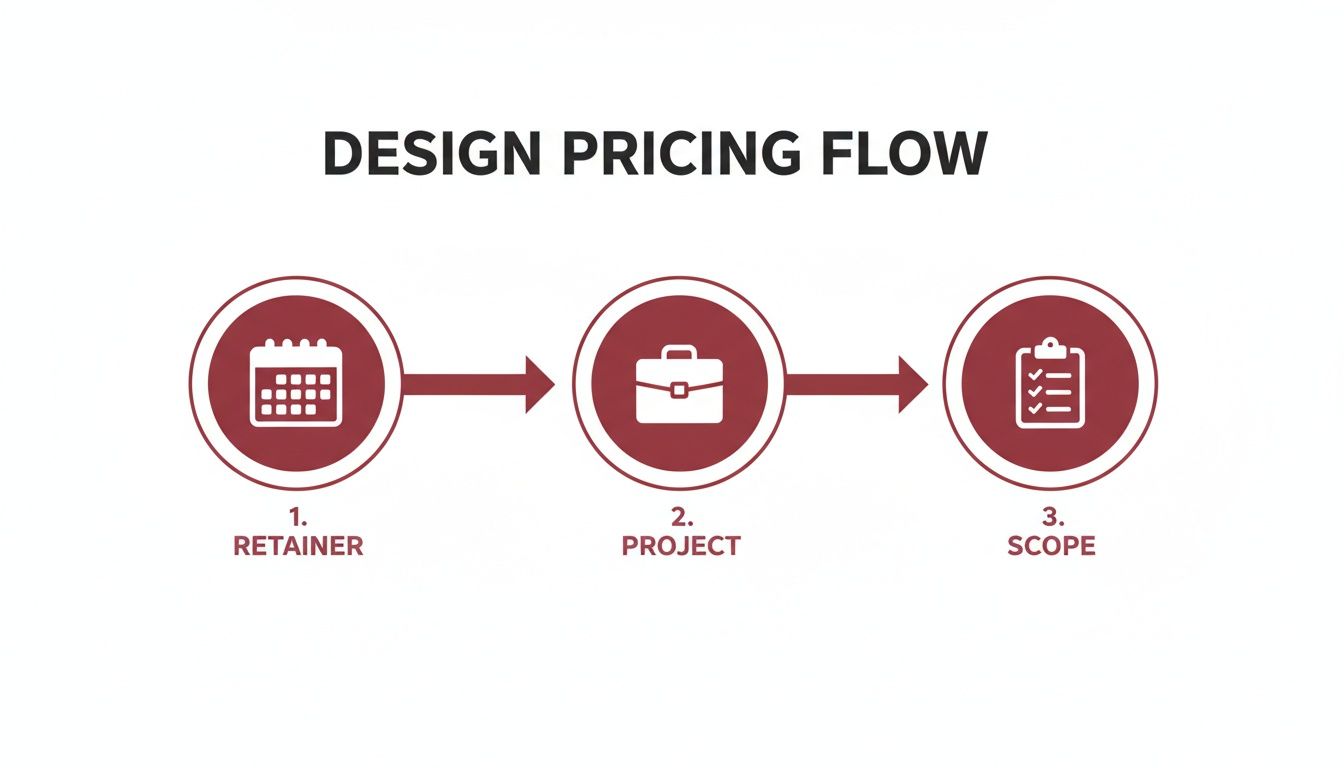
This visual guide shows how different pricing structures cater to distinct needs, from ongoing support to one-off projects. It clarifies that a successful partnership starts with choosing the financial model that best aligns with your business goals.
Your Client Onboarding Checklist
The agency will do most of the heavy lifting, but a smooth start is a two-way street. Being prepared on your end can seriously speed up the initial phase and give the design team what they need to hit the ground running. The more organised you are, the faster you’ll see creative concepts come to life.
Here’s a simple checklist of what you should have ready to share:
- Existing Brand Assets: Gather everything you have. This includes high-resolution logo files (in vector format like .AI or .EPS), any previous brand guidelines, fonts, and colour codes.
- Key Stakeholder Contacts: Provide a clear list of who from your team needs to be involved in approvals and feedback, along with their roles and contact info. This avoids confusion later on.
- Access to Accounts: If the project involves digital assets, be ready to grant the agency access to relevant accounts, such as your social media profiles, website backend, or Mailchimp account.
- Content and Photography: While your agency may be working on new visuals, provide any existing professional food photography or written content (like menu descriptions) you have. This gives them valuable context and can sometimes be repurposed. Collaborating with your team on a cinematic food video production can also be a powerful way to bring the brand to life alongside the design work.
By understanding this roadmap, you remove uncertainty and start the relationship on a foundation of clarity and collaboration, paving the way for a successful partnership.
Questions You’re Probably Asking About Hiring a Design Agency
Even after you’ve shortlisted a few agencies, some practical questions always pop up before you sign on the dotted line. Choosing a graphic design agency in Dubai is a big deal for any F&B business, so it’s smart to get total clarity. Let’s tackle the common concerns we hear from restaurant and cafe owners all the time.
Getting these answers straight helps you move forward with confidence, knowing you’ve found a partner who actually gets your business and its goals.
How Much Should I Budget for a Branding Project?
This is the big one, and the honest answer is: it depends. A simple logo for a new cloud kitchen might be a few thousand dirhams, but a full-blown brand identity for a multi-location restaurant—think menus, packaging, digital assets, the works—is a much larger investment.
The final price tag really comes down to a few things:
- Agency Reputation: An established, award-winning agency will naturally have higher rates than a smaller, up-and-coming studio.
- Scope of Work: This is the biggest factor. A full branding package with brand guidelines, several packaging templates, and in-store signage will cost more than just a logo and a business card. Simple as that.
- Complexity: If your vision involves custom illustrations, intricate patterns, or deep market research, expect that to be reflected in the budget. It just takes more time and skill.
Try to see it not as a cost, but as an investment. If a $5,000 investment leads to a 15% jump in your average order value, it pays for itself pretty quickly. The goal isn’t to find the cheapest option, but the one that delivers a real return.
What Happens if I Don’t Like the Initial Designs?
It’s a common fear, but don’t worry—a professional agency has a process built to prevent this exact problem. Those initial brand discovery workshops and kickoff meetings aren’t just for show. They exist so the design team can get inside your head and truly understand your vision, audience, and goals before a single pixel is pushed.
That said, design is subjective. If the first concepts don’t quite hit the mark, a good agency won’t panic. Their process will include a set number of revision rounds (usually two or three), which should be spelled out clearly in your contract. Your job is to provide specific, constructive feedback, and they’ll refine the designs based on your input. It’s a partnership, not a one-way street.
How Long Does a Typical Branding Project Take?
Timelines can vary as much as costs, but a good graphic design agency will give you a clear project plan from day one. A straightforward promotional campaign might take a week or two. A full brand identity project, from the first chat to handing over the final files, is more likely to take anywhere from six to twelve weeks.
Here’s a rough breakdown of what influences that timeline:
- Discovery and Strategy: The initial deep dive into research and planning usually takes one to two weeks.
- Initial Concept Design: Crafting the first set of visual directions often takes another two to three weeks.
- Revisions and Refinements: The back-and-forth feedback loop can take anywhere from one to four weeks. This really depends on the number of revisions and how quickly you provide your thoughts.
- Final Asset Creation: Once a design gets the green light, creating all the final files (logo suite, menu templates, etc.) takes another one to two weeks.
Keep in mind, your own response time is a huge factor here. A decisive client helps keep the project moving smoothly, while delays in feedback can easily stretch the timeline.
Who Owns the Final Design Files?
This is non-negotiable and must be crystal clear in your contract. Once the final invoice is paid, you should have full ownership and intellectual property rights to the final, approved designs. Period.
The agency should hand over a complete package of all the master files. We’re talking vector files (.AI, .EPS) for your logos, which can be scaled to any size without losing quality, plus print-ready (.PDF) and web-ready (.JPG, .PNG) versions of everything. Having these master files means your brand is truly yours—you can use it for anything in the future without needing to go back to the agency.
Ready to build a brand that captivates Dubai’s diners and drives real results? The team at Food On Focus Media are F&B specialists who blend stunning visuals with strategic thinking to help your business thrive. Learn more about our branding and design services at Food On Focus.